
Reaching For The Sky


Reaching For The Sky
How Humility Breaks the Ceiling Ego Builds
Dear friends,
Let us revisit the learnings from the first three messages of this Basant Bhandara:
- In The Divided Heart, we met the seeker torn between desire and aspiration, wondering which would prevail.
- In The Awakening of Purpose, we met the seeker whose energy was intact, but whose purpose had gone missing, a fire with no direction.
- In Building a Strong Foundation, we met the seeker who had practiced well and had felt the inner change but could not trust the transformation taking place in her own heart.
Now we meet a fourth seeker. This fourth seeker has travelled a little further on the inner journey. He has chosen well, is driven by purpose, and has ample trust in the path. And yet, he has stopped growing, not because the capacity is exhausted but because the very attainments that brought him this far have quietly become a cage.
As an analogy, think of a tree that has grown tall to reach the ceiling of a greenhouse. It faces a peculiar problem: its roots are healthy, its leaves are green, and by every visible measure it is thriving, yet it has stopped growing. It is not because it lacks the capacity to grow, but because it has encountered a boundary it cannot see through.
The greenhouse is the ego, and the ceiling is the story the ego tells itself. The tree, pressing against the greenhouse ceiling, mistakes it for the sky and believes it has reached its full height.
Ego: A Deceptively Subtle Obstacle
The ego is the most subtle obstacle on the spiritual path because it disguises itself as the path. The seeker most vulnerable to the machinations of the ego is the one who has accumulated years of practice, read the texts, earned the respect of the community, and can speak fluently about surrender and humility. By themselves, the attainments are not false, but the danger lies in their accumulation becoming an identity. And identity, however spiritual its costume, is still ego.
In The Divided Heart, we spoke of two wolves within the heart, one higher, one lower. Desire is the lower wolf, and it is easy to spot, as its hunger is obvious. Ego, however, is more cunning. It can wear the fur of the higher wolf, which implies that the ego can disguise itself as something ‘noble’. That is what makes it dangerous: it hides inside what appears to be a virtue. It may even appear as devotion or spiritual intensity.
Chariji once made an observation that should concern every sincere practitioner. He said that the field of spirituality is so soft and yielding that it becomes fertile ground for pride to manifest and manipulation to take root. Carefully consider what this means.
In the material world, the ego is constantly checked, as the market corrects you, competition humbles you, and failure teaches you. But in the spiritual world, these external checks are largely absent. You can build an empire of self-importance and call it devotion. You can accumulate decades of practice and mistake the accumulation for the goal. Nobody hands you a quarterly report on your inner condition to hold up a mirror to yourself. Hence, the very gentleness of the path is what makes the trap so effective.
The Paradox of Spiritual Accumulation
Growth requires two things: the willingness to receive and the space in which to receive it. A cup already full cannot be filled further. This is a precise description of what happens in consciousness when the ego occupies the space where growth would occur. The samskaras of spiritual pride are among the most difficult to dislodge because they feel like virtues. They might sound like:
“I have been practicing for twenty years.”
“I understand these teachings deeply.”
“I have sacrificed much for this path.”
Each statement may be factually true, but when it crystallizes into identity, it becomes a wall.
The ancient traditions call this abhimana, the subtle pride that infiltrates even the most sincere practice. It does not announce itself with arrogance. It whispers through comparison: “I am further along than they are.” It hides in false humility: “I am nothing,” spoken with the secret pleasure of being seen as humble. It even masquerades as devotion: “My connection with the Master is special,” as though the infinite could play favorites.
In Building a Strong Foundation, we described doubt as “fear dressed up in a lab coat pretending to be objectivity”. Doubt says, “What I have found is not real,” or “Is it even worthwhile?
Abhimana mirrors this in a different way, as “ego wrapped in spiritual language pretending to be surrender”. Ego says, “What I have found is mine, while secretly whispering, ‘I am nothing."
Both prevent the next step: doubt prevents you from seeing what you have, while the ego leaves no space for growth to hold.
Ego That Serves Versus Ego That Suffocates
Here is something important: ego is not the enemy. In the book Spiritual Anatomy, we explored the ego as a spectrum with five expressions: arrogance, pride, confidence, presence and humility. Arrogance is the grossest expression, the ego so inflated that it distorts every relationship and every perception. At the other end stands humility, which is not the absence of ego but its noblest expression, a state of total confidence in something far greater than oneself.
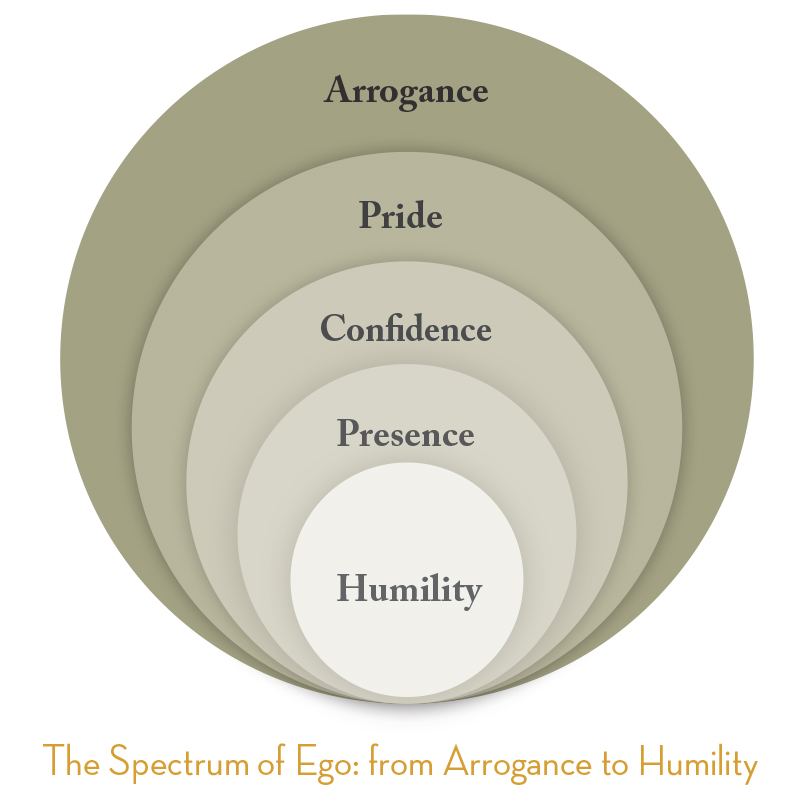
The ego is like a muscle; it needs to be strong enough to function, flexible enough to yield, and wise enough to know when to step forward and when to step back. For example, a person giving a speech needs a certain level of ego to carry it with conviction. The same person sitting in meditation needs the ego to recede almost to nothing, so that pranahuti can find open space. Thus, the problem is never the ego itself, but the rigid ego that has frozen at one setting and refuses to move.
In The Awakening of Purpose, we said that laziness is not a lack of energy but energy without a goal. In the same vein, ego, in its frozen form, is energy with a goal, but the wrong goal. The lazy person’s fire sleeps, while the ego-bound person’s fire burns, but it warms the greenhouse rather than reaching up to the open sky. This analogy indicates that the seeker’s spiritual energy, sincerity and the results of accumulated practice get diverted to maintain, defend and polish a self-image rather than to grow beyond it.
In The Divided Heart, we described how repeated failure creates micro-fractures in willpower, and invisible damage that accumulates until a minor overload causes catastrophic collapse. It means that every time you fail to use your will, it weakens, eventually collapsing.
Ego works in reverse. Repeated spiritual success, when claimed as personal achievement, creates micro-inflations. Each micro-inflation is invisible and feels like progress, but its cumulative effect is a rigidity that eventually prevents the very growth the practice was designed to produce.
What Nourishes Growth
If ego is the ceiling, humility is the open sky.
Humility is widely misunderstood; it is neither self-deprecation nor a performance of smallness. It is, in fact, the accurate perception of one’s place in the vast order of existence. The Himalayan peak is humble not because it stoops but because it knows it is part of a range that extends beyond what any single peak can see.
True humility is what remains when the need to be special dissolves. Ponder over this deeply. Many people assume that if the need to be special fades, then something valuable will be lost. The ego fears that it will shrink, become invisible, and lose its strength and self-image. That is the biggest misunderstanding.
When the need to be special dissolves, what remains is presence without performance, strength without self-display, and confidence without comparison. You are not reduced or diminished in any way; rather, you are freed from the burden of maintaining an image. You still have your unique skills, strengths and ideas, but your identity and self-worth are not limited to them.
The same energy that was used to maintain, defend and project the self-image is now available for growth. So, humility does not shrink you. It releases you.
In the Heartfulness practice, pranahuti works most powerfully in the heart that has made space for it. Transmission does not force its way in. It fills what is empty, and it waits at the threshold of what is full. This is why the greatest transformations often occur not in the seasoned practitioner but in the raw beginner who sits with no expectations, no framework, no spiritual resume. They have nothing to defend. The cup is empty. Grace fills it without resistance.
Think of it this way. In The Awakening of Purpose, we explored the ice cream paradox: a boy needs no willpower to want ice cream. When genuine interest exists, energy flows naturally. The same principle applies here. Humility requires no effort when genuine awe exists. The person who has truly seen the vastness does not need to practice humility. It arrives naturally, with sustained practice and openness. At a deeper level, we do not lack humility, but the problem is that the deceptive ego has placed itself between us and the vastness, reflecting its own image and obscuring the sky beyond.
The Continuous Beginner
The Japanese use the word shoshin to describe what they call the beginner’s mind. In the mind of a beginner, possibilities are many; in the mind of an expert, they are few. This does not mean pretending ignorance. It means approaching each moment, each meditation, each encounter with fresh attention, as if it were unfolding for the first time, because, in truth, it is.
The meditator who sits today expecting a repeat of what happened yesterday has already placed a ceiling on what is possible. The seeker who approaches the Master knowing what the Master will say has already decided to hear only what fits the existing framework. Growth happens in the space between what we know and what we are about to discover. The ego fills that space with certainty, while humility keeps it open.
In The Awakening of Purpose, we recalled the blank scroll from Kung Fu Panda, the popular animated film. When the scroll was finally opened, it turned out to be a mirror. There was no secret ingredient; the power had always been within. Yet this truth can be received in two different ways. Ego declares, “Yes, I am the power!” Humility recognizes, “The power moves through me.” The first statement builds a ceiling, while the second opens to the sky: it is the same truth, with opposite consequences.
Babuji’s third maxim says, “Fix up your goal, which should be complete oneness with God. Rest not till the ideal is achieved.” We have spoken of “Rest not” in the context of laziness, but it applies here with equal force. “Rest not” also means “Arrive not.” The moment you believe you have arrived, or that the journey is complete, the ceiling appears. Remember, there is always further to traverse, for there is an open, limitless sky.
This inner training is not a single act but a daily practice. The ego can reconstruct itself overnight; hence, each morning, the ceiling must be removed again. In each meditation, the cup must be emptied again. This is the rhythm of growth, the continuous release of accumulations in order to become more and more of who we already are.
The Limitless Sky
Babuji once described the humblest person as capable of leading a richer life than a king, with a heart that conceals the ‘wonder of wonders’ without anyone knowing it. This is the portrait of a soul that has broken through the ceiling. It does not advertise its height. It does not need to be seen as tall. It simply grows, like a tree reaching for the sky.
The tree that breaks through the greenhouse roof does not stop being a tree. It becomes free to express its real nature, now that it is exposed to real sunlight, real rain and real wind. With this new perspective, it now recognizes that the ceiling was never the sky, and that it can continue to grow.
In summary:
- In The Divided Heart, desire divides us till we learn to choose wisely.
- In The Awakening of Purpose, inertia stalls us till we light the fire and find our purpose.
- In Building a Strong Foundation, doubt corrodes us till we see right through it and learn to trust our own experiences.
- In Reaching for the Sky, we see that the ego encloses us, so gently and so gradually that we mistake the enclosure for the destination. We now learn that humility can break through the ceiling that the ego creates.
But of these four, desire at least has the honesty to announce itself as hunger. Laziness feels heavy, and doubt is uncomfortably tangible. But only the deceptive ego congratulates us for being stuck. It makes stagnation feel like an achievement. And that is what makes it the most dangerous obstacle of all.
The limitless sky has always been there. The only thing between you and the sky is the glass you built to protect yourself from the weather.
Know that you were always strong enough to endure the weather.
Now, break the ceiling and reach for the sky
With love and prayers,
Kamlesh
Message on the occasion of Golden Jubilee Celebrations of Yogashram Shahjahanpur Batch 3: 20 to 22 February 2026
Choose your language:


Other Languages