The Divided Heart


The Divided Heart
Dear Friends,
A man in his fifties sat before me. He was successful by every external measure, but his hands trembled slightly as he said, “I know what I want, and I know what I should do. And yet, when the moment comes, I find myself doing exactly what I promised myself I would never do again. Every time I fall, I lose a piece of myself. The regret is crushing, the shame burns, and still the pattern repeats.”
He was not speaking of violence, or theft, or betrayal of another. He was speaking of something more intimate, more persistent, and in its own way, more devastating—the war between desire and aspiration that rages within the human heart.
This confession comes in many forms: the middle-aged executive who cannot break free from compulsive patterns; the spiritual seeker who practices cleaning diligently yet finds the same tendencies returning; and the family man who knows that fleeting pleasure intellectually is a poor exchange for lasting peace, yet finds himself swept away when temptation rises. The particulars vary but the structure remains constant: a divided heart, one part pulling toward liberation, another toward bondage.
Inner Division
What does it mean when someone says, “A part of me wants freedom, and the other wants to follow my desire”? It means the heart has not yet decided, at least it has not chosen with its full weight. The aspiration for freedom is genuine and so is the pull of desire. Both exist simultaneously, and in the absence of a decisive inner movement, the stronger force wins in the moment of confrontation.
This is the conflict between Preya and Shreya, the pleasant and the good—a conflict that has been highlighted since Vedic times. When the mind is split, the inner cry lacks the resonance needed to reach the Divine, because half of the heart is still holding onto the shore.
Many seekers find themselves trapped here. They practice meditation, perform the evening cleaning, and follow the tenth maxim, repenting at bedtime for wrongs committed, begging forgiveness, promising not to repeat the same things again and again. And yet, the promise keeps being broken. Each broken promise extracts a toll—confidence erodes, willpower weakens, and a subtle despair begins to settle, a sense that perhaps freedom is meant for others, but not for them.
What has gone wrong?
The Two Wolves
There is an old teaching, passed through many cultures, about two wolves that live within every human heart. One wolf represents our higher nature—patience, kindness, truth, discipline, and love for what is eternal. The other wolf represents our lower nature—impulse, craving, deception, indulgence, and attachment to what passes.
A young man asks his elder, “Which wolf wins?” The elder replies, “The one you feed.”
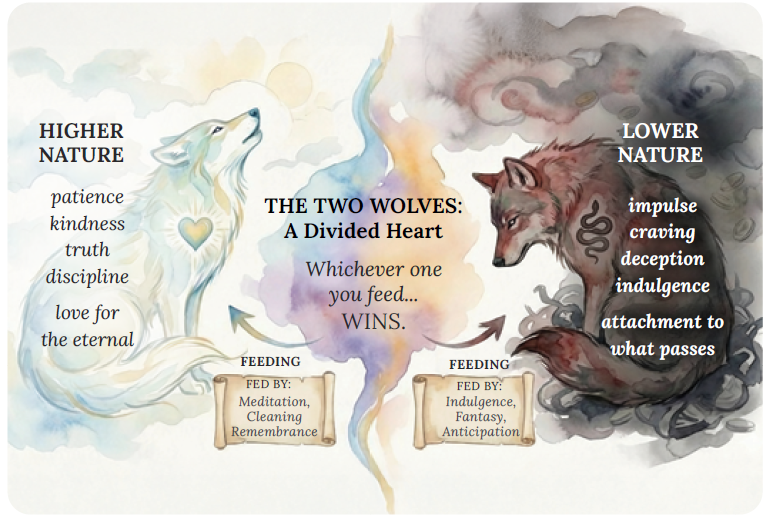
The teaching is simple, but its application is not. The seeker who struggles with persistent desire is feeding both wolves. In the morning meditation, the higher wolf receives its portion, and in the evening cleaning, the higher wolf is strengthened. In moments of clarity and resolve, the higher wolf grows.
Then comes a trigger, and the lower wolf, which has also been fed through indulgence, fantasy, and the secret pleasure of anticipation, rises with its own strength. And in that moment of confrontation, whichever wolf is stronger prevails. The problem is not that the seeker has a lower nature—everyone does. The problem is that the feeding has been too balanced so that both wolves have been kept alive and vigorous. The war continues because neither side has been allowed to weaken decisively.
Why Cleaning Alone May Not Suffice
The Heartfulness practice of cleaning is profound. Evening by evening, the seeker sits, visualizes the complexities and impurities of the day flowing out from behind, and receives the divine light entering from the front. Impressions lift and the system lightens. Freedom approaches. Yet some seekers report that despite years of diligent cleaning, certain tendencies remain stubbornly lodged. Their desires return, sometimes with greater force than before, and so the pattern persists. Why?
This is because cleaning removes what the heart is willing to release. When a tendency is secretly cherished, when some part of the psyche holds onto it with hidden affection, cleaning meets resistance. The technique continues to work at its own level. The deeper root remains protected by the very identity it serves.
Consider what happens when cleaning is performed in the evening after a day of succumbing to the same pattern once again. The mind repents, the heart feels remorseful, a prayer for forgiveness is offered, and a promise is made. The question is: How genuine is that promise?
The Half-hearted Prayer
There is a vast difference between wanting to want something and actually wanting it. A seeker who struggles with persistent desire may genuinely want freedom. In the moment of regret, the wanting is intense. In the moment of prayer, the aspiration feels real. In the quiet of meditation, liberation seems close.
Then the trigger appears. A situation arises and the old pathway lights up in the nervous system, often leading to reactions that are buried deep in the subconscious. Suddenly, all that aspiration for something higher evaporates. What remains is the raw pull of desire, and in that moment, the seeker discovers how shallow the roots of aspiration really were.
This is not hypocrisy, it is the human condition. The problem is not that we lie about wanting freedom. The problem is that we have not yet cultivated an aspiration deep enough to survive the confrontation. The prayer is real, but it is also half-hearted.
The Merchant and the Monk
A story from the tradition illustrates this well. A merchant came to a monk, troubled by his inability to stop cheating his customers.
“I know it is wrong, ”he said. “Every evening I vow to be honest, yet every morning I find myself lying again. What is wrong with me?”
The monk asked, “When you make your evening vow, do you truly want to be honest?” “Yes, absolutely,” the merchant replied.
“And when morning comes and a customer stands before you, do you still want to be honest?”
The merchant paused and replied, “In that moment, I want the sale more.”
“Then your evening vow is made by one man, and your morning choice is made by another. Until they become the same man, your vow will continue to break.”
The merchant asked how to make them the same.
The monk replied, “You must discover what you want more than the sale. When you find it, the lying will stop on its own.”
The Erosion of Will
There is a mechanical principle at work in repeated failure. Each collapse leaves the structure weaker for the next test. A bridge designed to bear a certain load can handle a slightly heavier load once, but if it happens repeatedly, micro-fractures develop. The bridge may still look solid but the damage is internal. Eventually, what seemed like a minor overload causes catastrophic failure.
Willpower functions similarly. Each time it is overridden, each time the clear decision of the higher mind is swept aside by the surge of desire, something fractures. The fracture may be invisible while the damage accumulates.
This is why the seeker who has fallen many times often reports feeling weaker than when they began. They expected practice to make them stronger, but repeated failure has eroded the very capacity they were trying to build. The solution is not to avoid testing the will; the solution is to stop setting it up for failure.
The Honest Assessment
Transformation begins with a ruthless honesty about the actual condition of the heart. Most of us overestimate our commitment to freedom and underestimate our attachment to our patterns.
This mis-assessment leads to promises that cannot be kept, which leads to the erosion described above.
What would honest assessment look like? It would mean admitting, without shame or defense, the exact proportion of wanting within. On a scale of one to ten, how much do you actually want liberation? And on the same scale, how much do you want the pleasure that your pattern provides?
For many, the honest answer is humbling. The aspiration for freedom might register as a five or six, while the pull of the pattern might register as an eight or nine. Given these proportions, the outcome of any confrontation is predictable. Yet, this is not a reason for despair; it is a reason for strategy. If your aspiration is weaker than the pull of desire, work on the aspiration. Don’t keep making promises the current proportion cannot support. Instead, focus on shifting the proportion itself.
What Increases the Longing?
Longing for the Divine does not grow through willpower; it grows through exposure and the osmosis that results from exposure.
When we spend time in meditation, something happens beyond our conscious experience. The system receives transmission, and the heart absorbs something of the condition being transmitted. Over time, repeated exposure creates a new baseline, a new normal, and a new sense of what is possible.
This is why Satsang, the company of truth, is emphasized. In the presence of a Master, or a devoted trainer whose longing has become total, something stirs in our hearts. A resonance occurs with the frequency of the higher wanting, and our own frequency begins to shift.
Similarly, time spent reading the words of those who have made the journey, time spent in contemplation of what lies beyond our patterns and tendencies, time spent in service that takes attention off the self all feed the higher wolf while the lower wolf receives less attention.
The shift happens gradually, so that one day we notice that the morning confrontation with another feels different. The reactive pull may still be there, but something else is also there— something that was not present before, or was present but weaker. The proportion has shifted.
The Quality of the Inner Cry
Babuji Maharaj once remarked that if the craving for God was as strong as the craving for worldly objects, realization would be instantaneous.
Let’s consider what this means. When a powerful desire arises, it engulfs our entire system. Thought, feeling, body, and will all align toward its fulfillment. Resistance crumbles because there is nothing of comparable strength opposing it. What would happen if the desire for liberation was equally as all-encompassing? It would not need to fight the lesser desire, as it would simply subsume it. Just as a great river absorbs a small stream, the larger current would carry all the waters in one direction.
This is why half-hearted prayer cannot transform us. This is why surface-level repentance bounces off the deeper patterns and tendencies. The intensity is mismatched: the longing for freedom is a candle while the pull of a habit is a bonfire. Until the proportions shift, the outcome is predetermined.
The Cocoon and the Butterfly
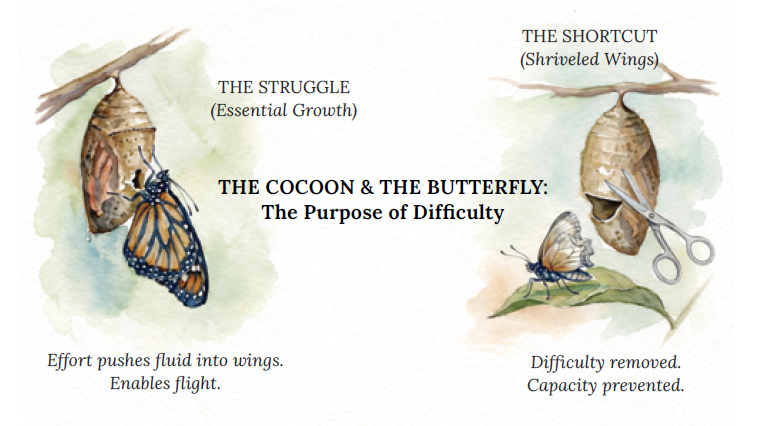
There is a story about a man who came upon a cocoon one day and watched the butterfly struggling to emerge from it. The opening was tiny and the butterfly pushed and strained for hours. Feeling compassion, the man took a pair of scissors and snipped the cocoon to make the opening larger. The butterfly emerged easily, but its body was swollen and its wings shriveled so that it could never fly.
What the man did not understand was that the struggle through the tiny opening was nature’s way of forcing fluid from the butterfly’s body into its wings. The so-called difficulty that seemed cruel was essential for the butterfly to develop its capacity for flight. Similarly, the seeker who wants God to remove the struggle from the journey may be asking to emerge with shriveled wings.
Many seekers pray for liberation from their tendencies. They ask God to remove their desires, to strengthen their will, and to make the path easier, but often nothing seems to happen. The desire remains, the will stays weak, and the path continues to be difficult. This leads some seekers to doubt and loss of faith. They think that God is not listening, God does not care, or God does not exist… but there is another possibility.
What if God’s response is to use the difficulty itself for transformation? What if the struggle is the means by which the seeker develops the very strength that liberation requires? Consider the alternative. If God simply eliminated every troublesome tendency upon request, the seeker would remain spiritually infantile. They would never develop the inner musculature that real freedom demands. They would be freed without becoming free. The struggle is not evidence of divine indifference, it is the curriculum.
The Moment of True Repentance
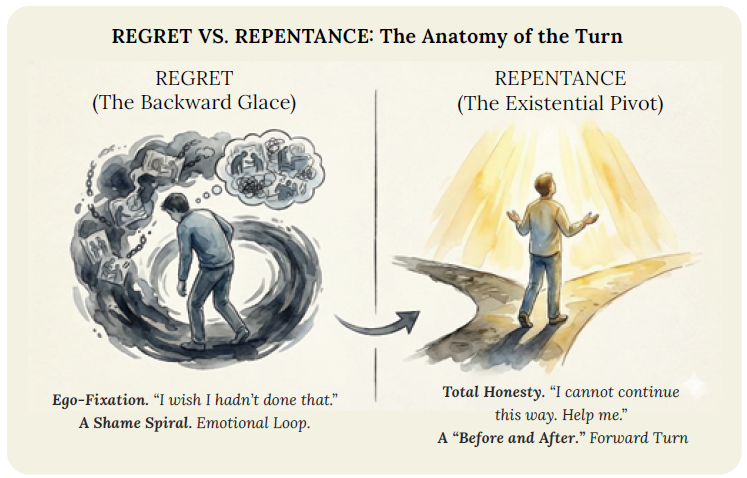
There is a difference between regret and repentance. Regret says, “I wish I had not done that. I feel bad about it, and hope to do better next time.” Repentance says, “I see what I have been doing, I see what it costs, and I see that I cannot continue this way. Something in me turns, now, in this moment, toward a different direction.”
Regret is emotional, and often associated with a progressively- heavier burden of guilt and shame, whereas repentance is existential. Regret comes and goes at the conscious level, while continuing to play upon our subconscious patterns, while repentance marks a clear before and after, demanding action to break the patterns.
The tenth maxim1 of Babuji Maharaj calls for repentance, not merely regret. The supplicant mood described by Babuji is not a mood of self-pity or sorrow, but a mood of childlike honesty before the Divine, hiding nothing, defending nothing, simply presenting the actual condition of the heart and asking for help.
When repentance is genuine, it does not make promises it cannot keep. Instead, it says, "This is what I am. This is what I have been doing. I do not know if I can stop but I know I want to stop. Please help me. ”This kind of prayer reaches deeper than our patterns and tendencies. Such honesty clears the way for grace to work where effort has failed.
What Our Behavioral Patterns Actually Want
There is a secret that instantly changes our relationship with desires: Our patterns do not want what they seem to want, but are actually pointing to something deeper. The craving for physical pleasure is, at its root, a craving for union. The restless seeking for momentary satisfaction is, at its root, a seeking for permanent fulfillment. The attachment to what passes is, at its root, an attempt to hold onto what is eternal. The patterns are not wrong in what they seek; they are wrong in where they are seeking it.
When this is understood, our patterns will be met with compassion rather than warfare: "I see what you are trying to find. It is not here but I know where it is. Come with me.”
1 Chandra, Ram., 2019. Commentary on the Ten Maxims of Sahaj Marg. Shri Ram Chandra Mission, India.
This response is different from fighting a pattern, or suppressing or denying its existence. Fighting only strengthens both sides, and denying keeps it festering in the subconscious, where it can still be triggered. On the other hand, shining a light dissolves the misunderstanding at the root.
The Turn That Changes Everything
At some point in the journey, something shifts. It is not a dramatic shift, and there is no fanfare. Often, we do not notice it immediately, but our center of gravity shifts. Previously, the heart was oriented toward the pleasure, with occasional glances toward freedom. Now, the heart is oriented toward freedom, with occasional tugs from the old pattern. The tugs continue but the orientation has changed.
This shift cannot be forced, but we can prepare for it. A person learning to sail a boat will capsize in strong winds and crashing waves; yet eventually, through consistent practice, they will become adept at sailing in all weather conditions. Similarly, our practice—daily cleaning, daily meditation, honest self-assessment, the accumulated consequences of falling, and the growing familiarity with what lies beyond our patterns—prepares us for the onward journey. Then, the shift itself happens by grace, in its own time, when the heart is ready.
For the One Who Keeps Falling
If you are reading this and recognize your own struggle, know that the falling has not been wasted. Every collapse has deposited something in you, and every recovery has built something. The very fact that you feel the weight of this suggests that something in you has not given up.
What is needed now is not more of the same kind of effort, but a shift in the quality of wanting. Here are some suggestions:
Stop making promises you cannot keep. Instead, make an honest assessment: How much do you actually want freedom? Measure it against how much you are pulled by your patterns of desire. Be precise, be unflinching, and become aware of the relative pulls.
Then ask yourself, “How can the proportions shift?” It will not happen through willpower or moral striving; it will happen through feeding the larger hunger while starving the smaller one. This will result from exposing yourself to the transmission that awakens the deeper longing, and keeping company with those whose orientation reminds you of your own highest possibility.
The Promise Worth Keeping
There is one promise worth keeping—the promise to keep trying. There is no point promising to succeed every time, as that is beyond human guarantee. To keep trying, to keep rising, to keep turning the heart toward what is highest are all within our reach.
The Divine does not measure progress by the absence of failure; the Divine measures progress by the persistence of aspiration. The seeker who falls a thousand times and rises a thousand and one has demonstrated something that matters—they have refused to abandon the path. This refusal is itself a victory, and the persistence is itself a transformation. In time, what begins as stubborn and sometimes mechanical effort ripens into a natural orientation. What was struggle becomes flow, and what was divided becomes whole.
The divided heart does not remain divided forever. One day, without fanfare, it simply finds its direction.
And when it does, it wonders why it ever moved any other way.
The war within is real. The path through it is honest longing. The outcome is already written in the nature of consciousness itself— what is true persists, and what is false withers away. Your work is to align with what is true, again and again, until the alignment becomes permanent.
That alignment is called freedom. And freedom is calling you home.
Om Shanti, Shanti, Shanti.
With love and respect,
Kamlesh
Pujya Shri Lalaji Maharaj’s Birth Anniversary, February 2, 2026
Message on the occasion of the 153rd Birth Anniversary of Pujya Shri Lalaji Maharaj February 1, 2 and 3, 2026, at Kanha Shanti Vanam
Choose your language:


Other Languages