February 2026
Book is not available in this language.
Building A Strong Foundation
Commitment, Purpose and Trust
Dear friends,
Over the past few days at this Golden Jubilee, we have been sitting with two questions that run deep in the spiritual life.
• In The Divided Heart, we explored the ancient war between desire and aspiration. It describes a seeker who knows what is right, yet is swept away when the moment to commit arrives.
• In The Awakening of Purpose, we examined the strange paralysis of a soul that has all the energy it needs but has lost its purpose, its reason to move. But there is still a third enemy; one that does not divide the heart or put the fire to sleep, but something far subtler. It is the one that waits until the heart chooses to commit, until the flame is lit, and the practice gives real fruit, but then it whispers, Are you sure?
That enemy is doubt. Of the three, it may be the most dangerous, because it does not attack those who have failed. It attacks those who are succeeding but refuse to believe it.
Not Trusting One’s Experience
One of our preceptors approached me about a situation concerning a sister abhyasi at her center. This sister had meditated for eleven years; eleven steady years. She spoke of the calm that filled her mornings, the patience that had gradually replaced her old reactivity, the new capacity to sit with discomfort without reaching for her phone.
Yet she would add, with the quiet unease of someone standing in a garden and wondering whether spring had truly arrived, “Is this real, or am I just fooling myself?”
Another abhyasi wanted to say, “Madam, if fooling yourself brings eleven years of inner peace, please write a book.” The rest of us are fooling ourselves into anxiety and calling it realism.
Just think over this: if this so-called self-deception has yielded eleven years of calm, shouldn’t it deserve a little more faith? And why don’t we doubt our worries as easily, even if they bring us nothing but unrest?
The sister abhyasi had everything except the one thing that would make it count: trust in her own experience.
Now, consider her situation in the light of what we have already discussed. Her heart was not divided; she had chosen wisely, and her inner fire was lit. She was practicing every morning, and unlike the man in his fifties from The Divided Heart, she was not torn between aspiration and desire.
She was also not the young lady from The Awakening of Purpose, whose motivation had gone missing. She had discipline, purpose and positive results.
And yet she stood paralyzed, because doubt had crept in. Her stagnation did not come from lack of discipline or aspiration, but from self-doubt; a subtle, quiet and destabilizing doubt.
This is why doubt deserves its own conversation. While desire attacks the will, and laziness attacks energy, doubt attacks something more fundamental: the capacity to recognize your own transformation.
The Subtle Poison of Doubt
Doubt differs from curiosity, as curiosity opens doors while doubt nails them shut and then stands outside complaining about the ventilation. Sahaj Marg draws a careful line between विवेक (viveka), the discriminative inquiry that leads to wisdom, and संशय (sanshay), the corrosive doubt that poisons perception.
Constructive inquiry asks, “Is this true?” It looks for what, how, where, and why?
Corrosive doubt asks, “Am I capable?” It clouds understanding.
One seeks clarity while the other questions identity. And once you start questioning your own identity, you are essentially arguing with the mirror.
In The Divided Heart, we reflected on the image of two wolves within us, one representing our higher nature, and the other our lower impulses. We understood that whichever one you feed ultimately prevails.
Doubt is neither of the wolves. Doubt is the voice that tells you that feeding itself is pointless. It sits outside the battle and whispers that neither wolf is real, that the food you are offering is imaginary, and that the whole enterprise of spiritual growth is a story you have been telling yourself. This is why it is subtler than desire or inertia. It does not compete with aspiration. It undermines the very ground upon which aspiration stands.
There is a beautiful exchange that shows how deep the territory of doubt runs. As Babuji entered the Central Region, the most refined plane of spiritual experience, he found none of the markers we associate with attainment: no sign of bliss, visions, or any kind of fireworks. It felt like nothing at all, to a mind accustomed to special effects. He confided in Lalaji: “My earlier days were a lot better. This feels like nothing.” Lalaji asked simply: “Should I remove this condition?” and Babuji replied instantly, “No, my Lord. If you do that, this will be my last breath.”
At that state, Babuji found neither beauty nor attraction, nor any recognizable pleasure. And yet, we see that the one who tasted it cannot exist without it. This is what lies beyond doubt’s jurisdiction: a condition so woven into being that removing it would be indistinguishable from non-existence. The soul does not argue about what it knows.
It is like discovering perfect symmetry at the very center of one’s being. It does not glitter or excite the senses. Yet once that inner balance is known, life feels stable and whole. Removing it would break or tilt the symmetry, thus destabilizing the individual.
The Architecture of Confidence
The Latin con-fidare means ‘with trust’. It does not guarantee success, but it signals deeper trust that you can navigate whatever comes in your life.
Doubt fractures this trust. The Latin dubius comes from a root meaning ‘two’, suggesting duality or division. Once the mind splits into the actor and the critic, it is as though you have hired an internal judge who never rests.
Doubt presents itself as a search for truth, and when a doubtful action fails because of the hesitation, it self-attests that it was right all along: “I told you so!” Thus, doubt manufactures its own evidence by producing outcomes that confirm its stance; a remarkably dishonest trick for something that claims to seek truth.
In The Awakening of Purpose, we discussed how laziness is not a lack of energy but energy without a goal. Doubt operates on a parallel track. Doubt is not a lack of experience but experience without trust. The lazy person has the fuel but no flame. The doubting person has both fuel and flame but keeps checking whether the fire is real, and in the checking lets the fire go cold.
The Bhagavad Gita is unsparing: it tells us Samshayatma vinashyati, the doubting self is destroyed.
The person who doubts their practice begins to doubt their path. The person who doubts their path begins to doubt their guide. The person who doubts their guide begins to doubt guidance itself.
Each instance of doubting is like pulling a thread on a sweater and being surprised when you end up shivering. You pluck away at the structure bit by bit, till nothing remains.
What about humility? Humility is not doubt. Humility says, “I do not know everything,” while doubt says, “I am not enough.” One opens the door to growth, while the other seals it shut and swallows the key.
Recall the bridge metaphor from The Divided Heart. We spoke of how repeated failure creates micro-fractures in willpower. It is invisible damage that accumulates until a seemingly minor overload causes catastrophic collapse. Doubt does the same to faith. Each time an experience is dismissed, each time the inner voice says “that was just imagination”, a micro-fracture appears in the structure of trust. The faith may still look solid from the outside, but the damage is internal. And one day, what should have been a minor wobble becomes a full collapse of confidence. Not because the practice failed, but because the accumulated dismissals finally broke the foundation.
This is the cracked foundation; broken not by failure, but by the refusal to acknowledge success.
Courage: The Antidote to Doubt
If you have been fighting doubt directly, you have been fighting on its territory, the home ground. It is indeed difficult to beat doubt on its home ground. The mind that debates with doubt has already lost, because doubt has infinite ammunition and absolutely no interest in reaching a conclusion.
Think of doubt as a permanent passenger in the vehicle of your life. It may talk, and it may even narrate elaborate disasters. It may predict sixteen different ways things will go wrong, but it should never be allowed to touch the steering wheel.
In other words, doubt might alarm, warn or comment, but don’t let it drive your life.
In The Divided Heart, we saw that the war between desire and aspiration is not won by fighting the lower pull but by increasing the higher longing until it subsumes everything else. The same principle applies here. You do not defeat doubt by arguing with it. You defeat doubt by accumulating so much direct experience that the argument becomes irrelevant. A person who has tasted honey does not need to debate whether sweetness exists.
Thus, the antidote to doubt is both direct experience and courage. Courage allows doubt to exist while refusing it the power to veto action. Direct experience dissolves it altogether.
Faith, on the other hand, operates differently from both doubt and certainty. It does not argue. It simply stands on ground that has been walked and says: this holds.
The Trajectory of Growth
Spirituality, at its essence, is the art of experiencing what we have long held as just beliefs. We begin with borrowed words, such as ‘God is love’, or ‘the soul is immortal’. These are beautiful beliefs, certainly, but beliefs are like promissory notes. Until the payment arrives, doubt keeps whispering, “What if the note is worthless?”
In The Awakening of Purpose, we noted that when something genuinely interests a so-called lazy person, they never tire, they do not eat, and they work all night without complaint. This indicates that energy was always there, but the flame was absent. There is a parallel here. When experience genuinely arrives, when the meditator feels something unmistakable in the chest, the intellectual debate about whether meditation works becomes absurd. Experience was always arriving, but the trust was missing.
The journey from belief to experience follows a precise trajectory. First, we feel. Something stirs in the heart during meditation; not an idea about the Divine but a felt encounter with it. But feeling is still a visitor, arriving and departing.
So the approach continues. What we feel often enough, we begin to become. The patience that once appeared only during meditation is now evident at traffic signals. The stillness that was a visitor becomes a resident, and eventually, a landlord. Then something deeper shifts. We no longer ‘practice’ patience, we become patient.
The chain of growth begins in a quiet decision made before dawn: I will sit. Not because I feel like it, but because something in me has decided, and that decision is not open to renegotiation. Resolve leads to practice, no matter what, where, when and how! Practice leads to experience. Experience produces a faith that no argument can shake, because it was not built from argument. It was built from the heart’s own testimony.
Each evening, through cleaning, we simplify the inner landscape. And here is the insight that changes everything: doubt requires a complicated narrative to survive. Simplify the inner landscape, and doubt simply starves. It needs drama the way a fire needs fuel. Remove the drama, and it has nothing to burn.
Now, recall the cocoon and the butterfly from The Divided Heart. The man who snipped the cocoon to make things easier only got a butterfly with shriveled wings that could never fly. Doubt does something equally destructive, but from the opposite direction. Instead of removing the struggle prematurely, doubt tells the butterfly that the wings it has grown are not real. While the struggle is over, the wings are strong, and the capacity for flight is fully developed, but doubt says, “Are you sure you can fly? Perhaps you should stay in the cocoon a bit longer. Just to be safe.” The butterfly that listens to this voice will never take off. Not because it cannot fly, but because it has been persuaded that its wings are imaginary.
The Foundation That Holds
Now return to our sister abhyasi who meditated for eleven years. She believed. Then she felt something: calmness, patience, equanimity. She crossed the first threshold without noticing. Then the felt experience reshaped her character. She crossed the second threshold, too. And yet she stood there, asking, “Is this real?”
Doubt had not prevented her transformation, but had done something more subtle: it had prevented her from recognizing it. The mind trained in doubt will dismiss each experience as it arrives: “That was just relaxation. That was just imagination.” Recognize this dismissal for what it is: not intelligence, but fear dressed up in a lab coat pretending to be objectivity. She did not need more experience. She needed confidence and courage to trust her experience.
In The Divided Heart, we described seekers who keep making promises they cannot keep, who overestimate their commitment to freedom and underestimate their attachment to patterns. This abhyasi had the opposite problem. She underestimated her transformation and overestimated the authority of her doubt. She was a successful seeker who could not see her own success.
The divided heart doubts its commitment. The sleeping fire doubts its energy. The cracked foundation doubts its own solidity. Of these three, the last is the most severe, because the foundation is already in place. The work is already done. All that remains is to trust it.
The confidence that carries a seeker through this recognition is not the naive confidence they started with. Life shatters that, and perhaps it must. But from the wreckage emerges something deeper: the quiet knowing of one who has doubted and practiced anyway, who has moved from believing to feeling to becoming, without needing applause. This second confidence does not mean you never encounter doubt; rather, it means you do not let it run your life.
Each morning, meditation takes you deeper than belief. Each evening, cleaning strips away what is not yours. Each act of courage weakens the authority of doubt. You have been walking this path: your own mornings attest to it, and your own patience reveals it. Your own heart, quieter now than it was years ago, proves it. The only question remaining is whether you will trust what your life has already shown you, or stand at the threshold of your own becoming, forever asking for one more proof.
One Antidote For All
Over these three messages, we have mapped the inner territory together:
The Divided Heart exposed a heart torn between what it wants and what it knows.
The Awakening of Purpose showed the futility of energy without purpose.
Building a Strong Foundation reinforces trust in our own experiences by preventing doubt from undermining them.
These are three poisons, which can stall your journey. And yet, as we look at them together, a single thread runs through all three.
Millennia ago, Ashtavakra gave a teaching so compressed it could fit in a single breath: Vishayanvishavat tyaja. Abandon the objects of the senses as you would abandon poison. For Ashtavakra, the vishayas (sense objects) were the poison; the seductions of the outer world, the endless parade of attractions that scatter the mind and keep the soul tethered to surfaces.
Babuji, speaking from the depths of his own realization, identified a subtler poison still: “Doubt is a poison to spirituality.”
Notice how these two warnings complete each other across the centuries. Ashtavakra warns against the poison that enters from the outside: the world pulling you away from yourself. Babuji warns against the poison that arises from within: the mind turning against your own experience. One corrupts the seeker who looks outwards for fulfilment. The other corrupts the seeker who has already turned inwards but refuses to trust what is found there. Together, they map the entire territory of spiritual danger. The outer poison says, “Look elsewhere.” The inner poison says, “What you have found is not enough.”
And what of the poison in between, the heaviness that settles when purpose drains away? That, too, is covered. The vishayas scatter attention outwards. Doubt corrodes trust inwards. And purposelessness, the tamas we explored in The Awakening of Purpose, is what fills the vacuum when both the outward pull and the inward trust are lost.
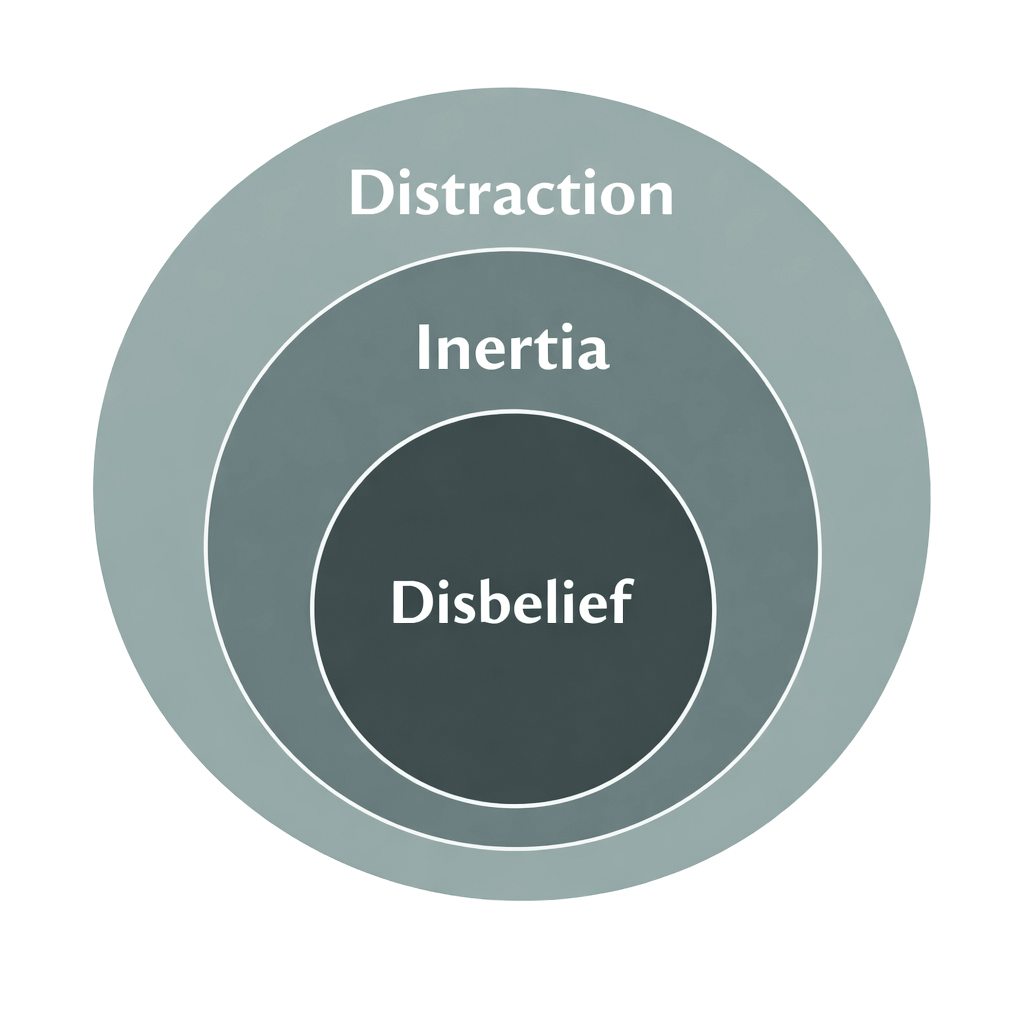
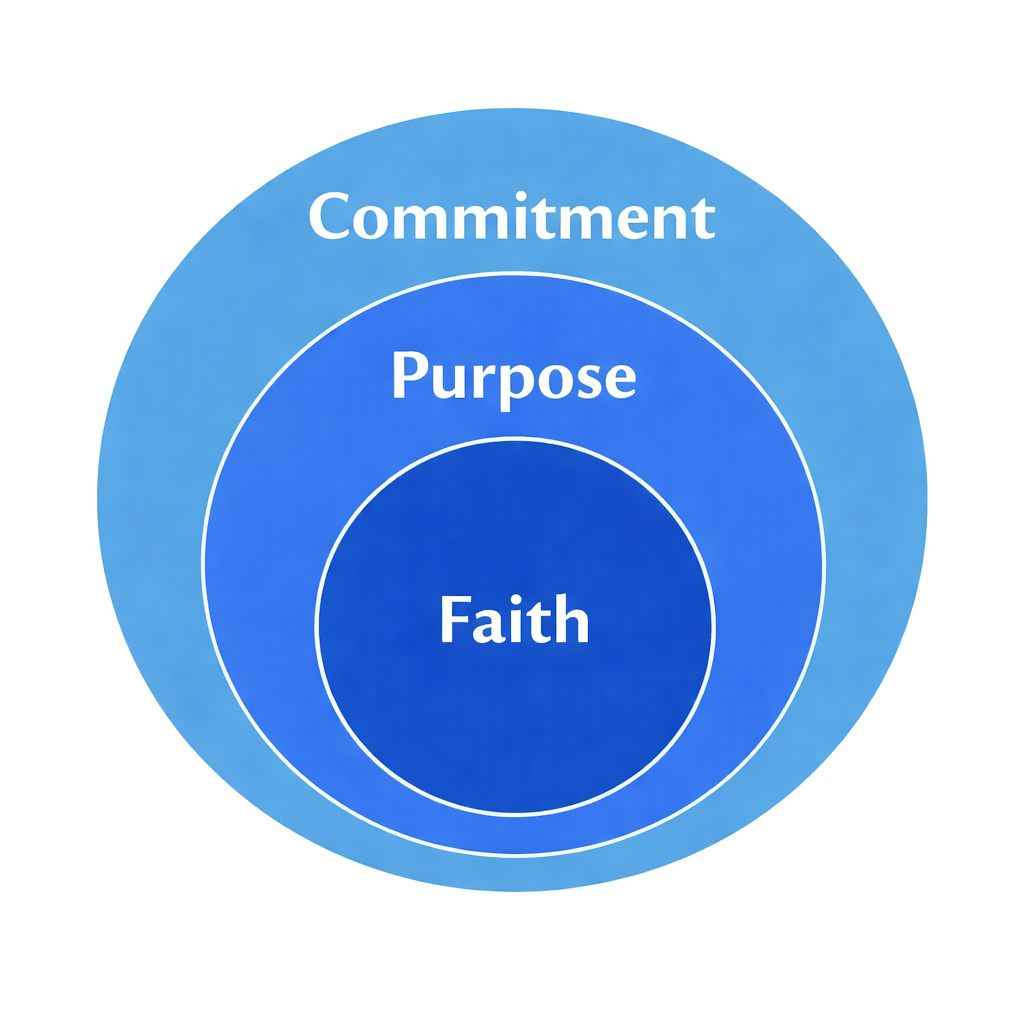
Three poisons: distraction, inertia and disbelief. The outer, the middle and the inner. Three antidotes: commitment, purpose and faith. The outer, the middle and the inner.
The old wisdom says: Himmate marda to madade Khuda. It means that when we summon the courage to take one step, the Divine covers the remaining distance.
The divided heart needs the courage to choose.
The sleeping fire needs the courage to move.
The cracked foundation needs the courage to trust.
And in each case, the moment we summon that courage, something larger meets us halfway. The antidote to all three poisons is the same: faith and courage working as one.
With love and prayers,
Kamlesh
Message on the occasion of Golden Jubilee Celebrations of Yogashram Shahjahanpur
Batch 2: 16 to 18 February 2026