July 2026
Dear ones,
Imagine two people sitting in the same meditation hall, receiving the same transmission, hearing the same words and closing their eyes at the same moment. After the meditation, one of them rises and something has shifted, quietly and irreversibly, like a compass needle finding north for the first time. The other rises, checks the time, and wonders what everyone else is feeling. The transmission, the silence and the words are identical, but there is a difference. What is it? Hold that question as we will return to it.
In a similar way, imagine a potato and an egg being boiled in a pot of water. The potato softens while the egg hardens, even though the water, the heat and the duration of cooking are all the same. What we each carry within us determines whether our experience opens us or closes us further. And this is not a question of talent or worthiness but simply a question of soil.
The Word That Has No Translation
In the previous series of messages, we walked together through the seven inner obstacles that stand between a seeker and the life that awaits. We saw how desire divides, inertia smothers, doubt corrodes, pride encloses, envy cripples, prejudice seals the windows and fear, the mother of them all, locks the door from the inside. In ‘The Unlived Life’, we discovered that faith turns the key to open the door and the first thing we find on the other side is not a destination but a quality of ground. The ancients called it shraddha.
The English translation of shraddha is ‘faith’, but it is not complete. Faith is often described as believing what you cannot prove, whereas shraddha is something far more alive. It is trust, self‑confidence, sincerity, determination, loyalty and inner conviction fused into a single flame. It is not just the mind agreeing to a proposition but the whole being orienting itself towards the heart’s truth, even before the intellect has finished weighing the evidence.
The learned ones describe faith as believing in the scriptures and the Master, and through this, achieving what is possible. Now, the subtlety hides in the word ‘believing’: it is not the passive acceptance of an idea but the active alignment of every faculty towards a truth that has been tasted, not merely told.
Sage Patanjali, the great cartographer of inner experience, placed shraddha first in his sequence of five qualities that lead to the highest realization, those five being shraddha (faith), virya (energy), smriti (remembrance), samadhi (absorption) and prajna (wisdom). Notice the order: shraddha fuels the energy or willingness to exert; energy sustains remembrance; remembrance ripens into absorption; and absorption flowers into wisdom. The entire chain depends upon the first link. Remove shraddha and the rest collapses like a staircase with no ground floor.
The Confidence You Did Not Expect
We often think of shraddha as faith in God, in the Guru and in our practice, and it includes all of these. But it may surprise you to know that shraddha begins closer to home, with ourselves. When we are without self‑confidence we lack faith. When we do not trust our capacity to walk this path, it does not matter how luminous the path is. When we do not believe we have chosen rightly, no amount of grace will feel convincing. The doubt will keep returning, not because the experience is insufficient, but because we do not trust our own reception.
Think of what this means. Do you remember, in ‘Building A Strong Foundation’, the woman who had meditated for eleven years and still asked, ‘Is this real?’ Her practice was impeccable and her transformation was visible to everyone around her, yet she could not trust it. Why? The doubt was never about the practice but about herself. She did not trust her own capacity to be transformed. She was like the egg in the boiling water, hardening around the very experience that was meant to soften her. Shraddha would have settled that question long before it arose, not by arguing with her doubt, but by providing a ground so firm that doubt could find no crack to enter.

The English translation of shraddha is ‘faith’, but it is not complete. Faith is often described as believing what you cannot prove, whereas shraddha is something far more alive. It is trust, self-confidence, sincerity, determination, loyalty and inner conviction fused into a single flame.
This is the dimension of shraddha that we most need to hear: faith in ourselves is as fundamental for spirituality as surrender to the divine will. And the two are not in tension; they are the same movement seen from different angles. When you trust yourself enough to let go, it is surrender. When you trust the Divine enough to believe you are worthy of its attention, it is self‑confidence. Shraddha holds both in one hand.
What Grows in the Soil?
A seed does not choose the soil upon which it falls, but a seeker does. And the soil the seeker prepares determines everything that follows. Where there is no real confidence, there will be no real love and no real surrender; where confidence is real, a living architecture of the soul unfolds:
Shraddha is the ground upon which love grows. Devotion is love that has found its direction. Surrender is devotion that has released its grip on the outcome. Mergence is what remains when even surrender has been surrendered.
Let’s explore that sequence again, slowly:
Each grows naturally from the previous one the way a bud becomes a flower, and a flower becomes a fruit. While you cannot force a bud to fruit, you can prepare the soil and let the sun do its work.
Now, here is the truth that will occupy us throughout this new series: when layavastha happens, the real journey begins. Please spend some quiet time with that statement. Almost all spiritual traditions and teachings point towards union as the destination. But the mystics who have been there speak of something more: the summit is not a destination, it is a doorway. The life you thought you were seeking is only a preparation for the life that awaits on the other side, and that preparation begins in the quality of the soil.
Shraddha is the ground upon which love grows. Devotion is love that has found its direction. Surrender is devotion that has released its grip on the outcome. Mergence is what remains when even surrender has been surrendered.
Not Tepid, Not Blind
There is a whispered instruction that carries a quiet thunder: faith cannot be tepid. If yours feels lukewarm, please review your objectives and act on them. Shraddha is fervent and determined, burning with the quiet intensity of a lamp that no wind can extinguish, not because the flame is violent but because the oil is deep.
Neither is faith blind. It is born of encounter, with something that shifts your inner world. This is what separates faith from mere belief, which can be inherited like a family heirloom that no one examines too closely. You can believe because your parents believe or your community believes, because it is easier to believe than to question, but shraddha does not work that way, it is direct. When you sit in meditation and feel, unmistakably, a presence that thought cannot manufacture and memory cannot fabricate, you have begun to build shraddha. Your own heart has become the evidence.
This is why meditation is not merely a technique in the Heartfulness way; it is the laboratory where shraddha is forged. Each meditation that opens a window to something real adds a layer to the ground beneath your feet. And over time, that ground becomes so solid that when doubt comes knocking, as it always does, your house will not shake. It is not that you have answered every question; rather, you stand on ground that the questions cannot reach.
The Life That Proved It
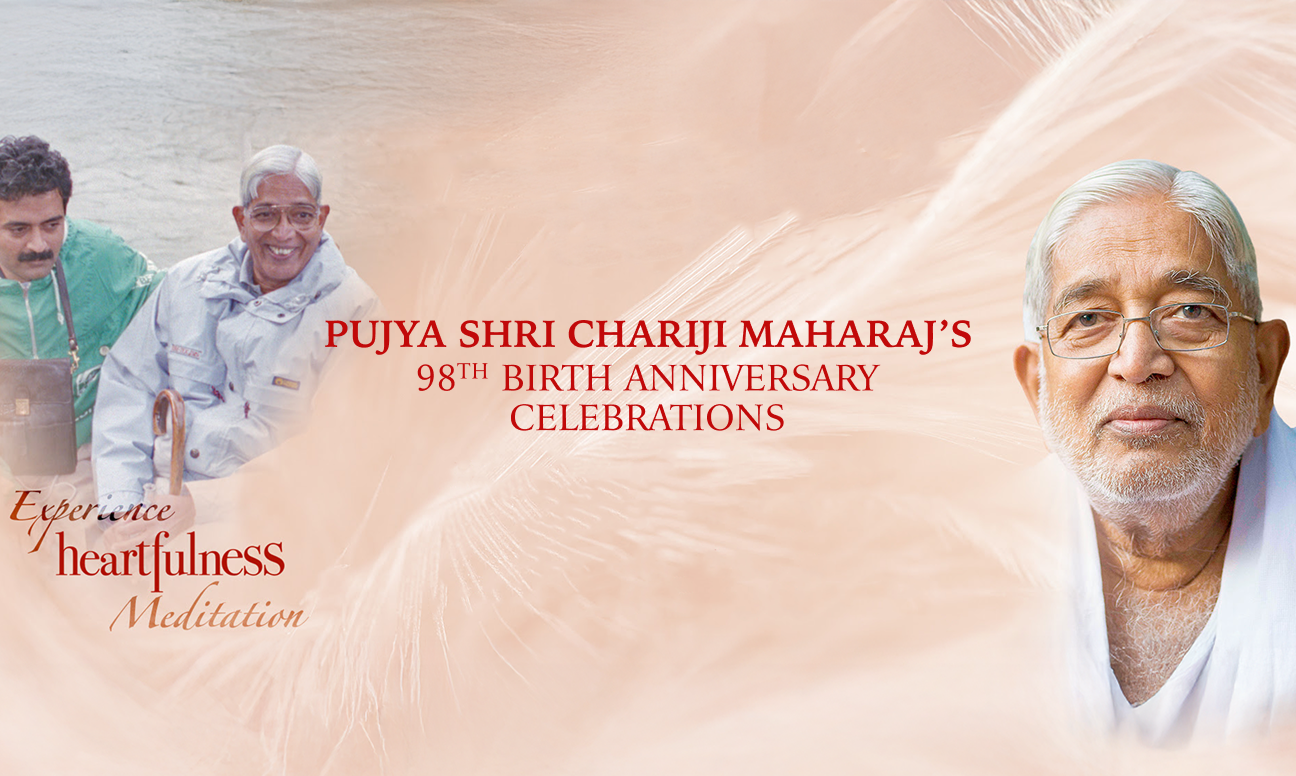
Today, as we celebrate ninety‑nine years since the birth of Chariji Maharaj, it is worth pausing to reflect on everything this message describes. He was a man trained in science and seasoned in industry, with a mind built for scrutiny, who met his Master and offered a faith that was never blind because he tested it in the laboratory of his own heart every single day. It was never tepid because it consumed his entire life. His heart was the prepared field. When transmission fell upon it, the harvest fed seekers across the whole world, and it feeds us still. He did not ask us to admire his faith; he asked us to grow our own. The finest tribute we can offer him is a heart made ready.
The Two People in the Meditation Hall
Let’s return to the two people who were meditating and answer the question with which we began. What was different? The soil. One heart had been prepared, not perfectly or completely, but it carried a willingness, a quiet conviction that something real might happen, a trust in its own capacity to receive. That willingness was not talent or luck, it was shraddha. Like the potato in the boiling water, that heart softened under the heat of transmission, opening itself further to what was being offered. And this quality can be cultivated by anyone who chooses to cultivate it.
The other heart was not barren. Let’s be clear that no heart is ever barren. It was simply unprepared, perhaps distracted, guarded or carrying the residue of an old disappointment that whispered, ‘Do not hope too much.’ Is that whisper familiar? It is the last echo of the very fear we spent eight messages dissolving, and the antidote remains the same as it was, not a grand gesture but a small, irreversible step. So, meditate again tomorrow with even a fraction more openness. Let the heart be a little less defended. That fraction will be enough. Shraddha does not arrive fully formed; it grows the way soil deepens, one season at a time, one meditation at a time, one act of quiet trust at a time.
We are all like little children who need reassurance, carrying deep‑rooted fears handed down through the ages. Shraddha is the reassurance the soul gives to itself. It is the moment when the child stops looking outwards for permission and discovers that the ground beneath their own feet has been solid all along, always there, waiting to be trusted.
Prepare the soil and you will discover that the seed already knows what it wants to become.
With love and prayers,
Kamlesh

Message on the occasion of the 99th birth anniversary of Pujya Shri Chariji Maharaj
July 24, 2026