12 September
Role of Consciousness
Q&A with Daaji
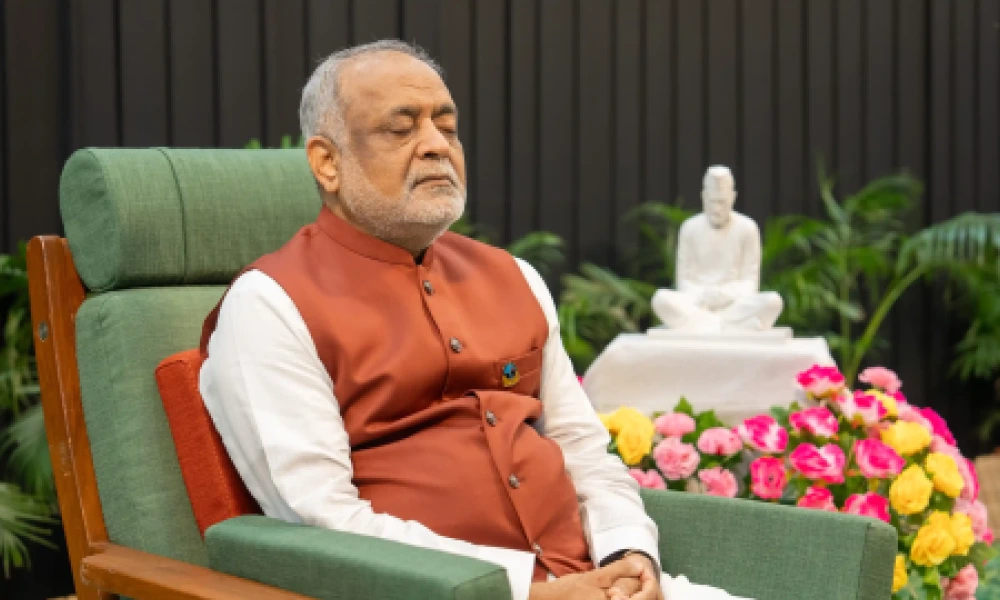
The evening program was arranged at a local convention hall where among the veteran and new abhyasis, there were many seekers who had come to experience Heartfulness meditation for the first time. After the meditation, Daaji answered two questions.
Q: What is the inner consciousness and how do we develop it?
Daaji: Consciousness has always been there. Even when we will not be, it will always be there. For example, do we really see the actual sunlight? No. We see the objects when it falls on them. Consciousness is everywhere, like light. If you keep your doors and windows closed, then you will not be able to see the luminosity, the light that emanates. You will see only darkness, though the light is very much there. Consciousness is our ability to perceive, to become aware. And it changes from person to person. For example, your mother may be sick. Your sister might notice her sickness before you would or vice versa. This is one level of consciousness/awareness—who perceives it faster? The next level of consciousness is how one responds responsibly. You may say to your mother, “Let me go to work. I will get the medicine for you on my way back from work.” But then what will happen to her in those eight hours? And your sister might say, “Let me sit with my mother, massage her feet or head and have someone get the medicine for her.” So we have to understand the situation. And this ability to perceive and act according to the situation is the function of our consciousness.
This consciousness gets affected at multiple levels because of mainly three aspects:
- First is our desires. One may say, I want to serve my mother, but my desire is to go to work. So it depends which desire dominates in a particular circumstance.
- The second is your intellect. It will analyze, “I spend some time here [with my sick mother] versus if I go to my office and work.” You will look at the profitability of the situation.
- The third is our ego. Suppose you had a fight with your mother, who is sick at that moment. And because you fought with her, your ego is hurt, and you say, “Let me avoid her, let her suffer.” This is your ego talking.
So these three aspects change our ability to perceive. But through our own purification, we are able to perceive things better and act appropriately. That is why when we close our eyes, many times we get so many thoughts. And these thoughts are not just irrelevant ones—they are there to remind us what to do, what we have avoided, and what we could have done better. They remind us of our guilt, our defects, and all the things that we have not done properly. They attack us during meditation. They don't leave us, until we understand very clearly, “Let me do things properly, responsibly.” And that is the fundamental role of consciousness.
There are 18 chapters and 700 slokas in the Bhagavad Gita and they are divided into 3 major categories: Karma Yoga, Jnana Yoga and Bhakti Yoga. Chapters 1 to 6 are all about karma, what you should be doing and what you should be avoiding. Chapters 7 to 12 are all about Jnana and Bhakti. Our life is also like that, existential, emotional and spiritual.
First is existential. Without karma you cannot exist: you have to work, work and work. It can be both karma as well as trauma. It falls in that category.
Second is emotional fulfillment. Everyone needs that. To be pampered, to receive affection and share affection. These are all human needs.
And the third, the highest, is spiritual fulfillment. You may have existential satisfaction, you may have emotional fulfillment, but without this spiritual fulfillment, your life will remain unfulfilled. It is like you have failed in the fifth class, and you have to repeat the fifth class. So if we fail in the spiritual realm, failing to fulfill our spiritual responsibility, Nature throws us back into the cycle of birth and rebirth. So, it is very important to become aware of our responsibilities towards the Self. The purpose for which we took this birth should take priority.
We also must act on all levels of responsibilities—toward the family, community, country, and planet. But this acting on all levels cannot happen without becoming fully aware, fully conscious of the inside, and also of the outside. Only then will such a person not pollute the air; such a person will not pollute the water, or the earth, etc., because their mind is pure and unpolluted.
It is thought pollution that creates many levels of pollution. So meditation is the key. Keep doing it regularly and don't ever ignore the process of purification, Cleaning.
Q: When I meditate every day, I feel a special energy around me, but when I don't meditate for 1 or 2 days, I feel that it is not there or that I have lost it, why is it so?
Daaji: The cause is that you are not careful about your daily meditation. Do it regularly. It only shows you that “when I don't meditate, I don't feel.” So meditate. Don't skip it. To me, meditation is the most important thing, a part of our existence. You may not eat for a few days and it's okay, but never skip meditation, even for one day. It’s like this: suppose I have to make a building, I make it with one brick at a time. I put one brick, then another brick, then the third one, and that's how we build the walls. My spiritual empire is built brick by brick, one meditation at a time, second meditation, third meditation, and so on. It's a daily thing. You skip one, one brick is gone. It will remain hollow. So, consistency, regularity, discipline, and more than anything, how you meditate is important.
Some masons will put the bricks haphazardly, then the finished wall looks ugly. When a professional mason lays the bricks, it looks so perfect that the wall does not even require plaster.
Our worship, our bhakti [devotion] should take us to the highest. It should be the highest expression of our love. We should not worship because we need something. If you worship because you need something, then it becomes a business. And you can do business with others, but not with God. He knows your intentions, your thoughts, and your actions. You cannot cheat Him. And He's not a fool. In the process, you will only hurt yourself. And there is no point asking for anything from God. He may give you the whole world, but if he holds himself back, you're still a beggar.