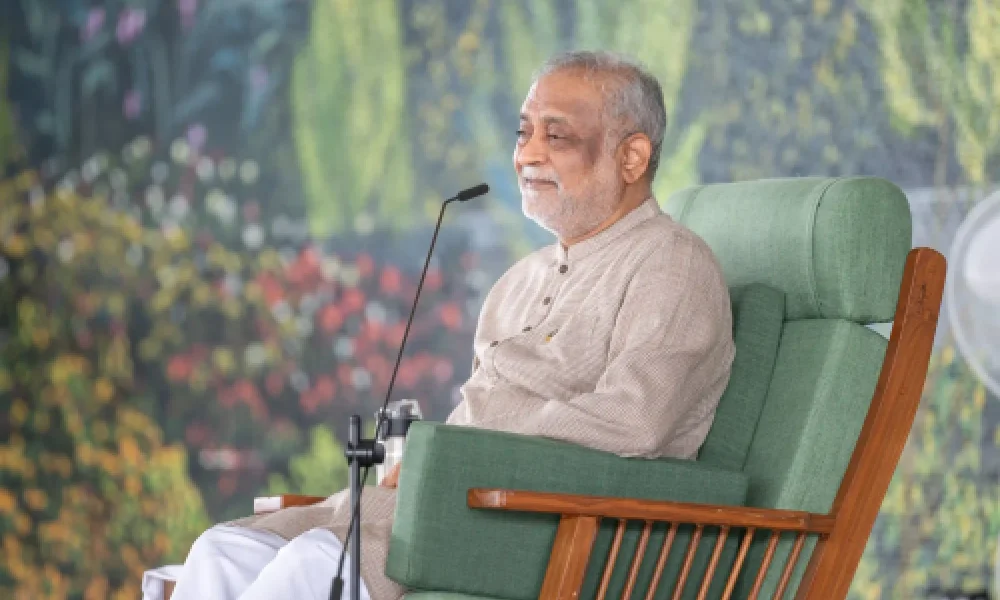
He then went to his office where he met with a senior officer of the Indian Navy. The Vice-Admiral, Anand Sardesai, asked Daaji several questions on the nature of combat and war. The dialogue between the Vice-Admiral and Daaji delved into the complexities of predicting future events of destruction as predicted by many a sage and oracle. The Vice Admiral was very curious regarding the philosophical nature of being a warrior. Daaji articulated that predicting the future was inherently difficult due to its dynamic and fluid nature, heavily influenced by the actions and will of people. While it was possible to foresee certain events in astrology, these predictions could be altered by human intervention. However, once a path of destruction was initiated, it became a matter of when, rather than if, it would occur. Daaji referenced the Heisenberg Uncertainty Principle to highlight the inherent uncertainties in making precise predictions, explaining that just as it is difficult to determine both the position and momentum of a particle simultaneously, predicting the exact timing and location of future events is equally challenging.
To illustrate his point further, Daaji drew on historical epics like the Ramayana and the Mahabharata. He recounted how the destinies of key characters were altered by human emotions and actions. For instance, in the Ramayana, although the horoscopes of Rama and Sita predicted happiness, their lives took a tragic turn due to the jealousy of Kaikeyi and the ego of Dasharatha who preferred sending his beloved son to the forest rather than break a vow given to his wife, however incoherent her request to him seemed to be. Similarly, the great wars in both the Ramayana and the Mahabharata were precipitated by what could be termed as the “arrogance" of Bhishma and Dasharatha, respectively. Daaji boldly suggested that if these figures had been humble enough to reconsider their oaths and promises, the outcomes could have been vastly different.
Addressing the Vice-Admiral's perspective on warrior ethos, Daaji emphasized that being a warrior was not merely about engaging in violence. Instead, it encompassed a broader responsibility of protecting the weak, fostering compassion, teamwork, and a commitment to peace. He referenced the Bhagavad Gita, where Arjuna grappled with the moral dilemma of participating in destruction. Daaji underscored the importance of maintaining righteousness, which is often more challenging than it appears. He humorously remarked that if divine figures like Krishna or Rama were to spend time among people today, they would quickly become burdensome, as people prefer to honor them in temples rather than integrate their principles into their daily lives.
Daaji also critiqued present-day worship practices, noting a significant departure from the genuine spiritual connection that characterized Vedic times. He lamented that contemporary rituals often lacked true feeling and had become a form of escapism. In contrast, during the Vedic era, people felt a profound connection with nature and divinity, perceiving God's presence in themselves, the sky, rivers, mountains, and the cosmos. Daaji argued that today's worship often involved external rituals without an internal spiritual experience, marking a degradation of the original essence of Hinduism.
In summary, the dialogue covered the unpredictability of future events, the philosophical nature of being a warrior, and a critique of modern worship practices. Daaji's insights highlighted the importance of humility, compassion, and genuine spiritual connection in navigating life's challenges and maintaining righteousness.