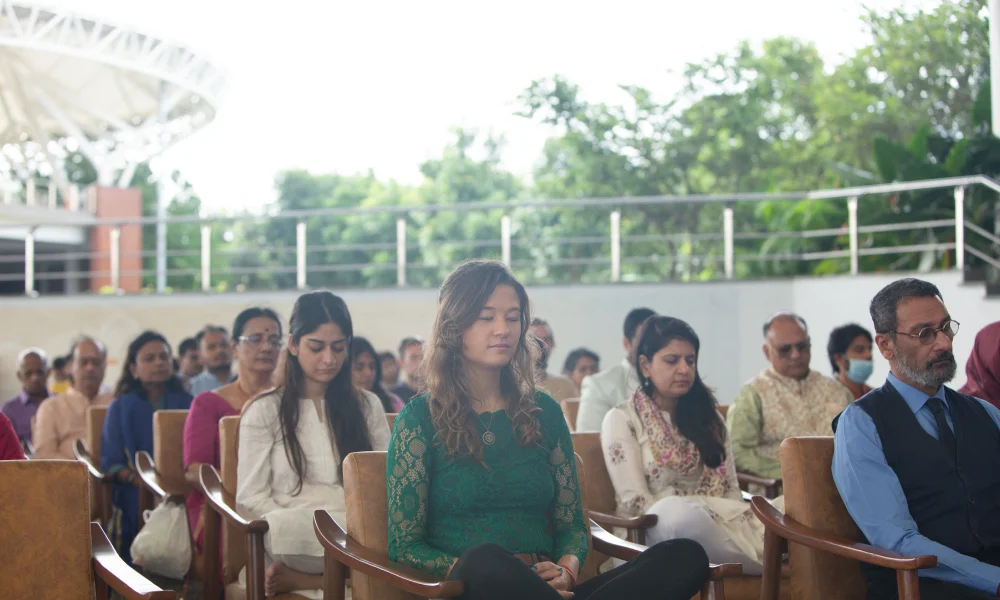
Afterward, he gave a profound talk, gems from which are shared below.
Rising with Kindness
Very dear friends, we at Heartfulness are honored to have you all amongst us at Kanha Shanti Vanam. It is a rare and privileged opportunity, especially since UNESCO has come forward with this brilliant topic of kindness.
A few months back, when the UNESCO representative, Anantha Duraiappah came here, he broached this topic in a very subtle way. He sowed the seeds of this conference at Kanha. And who else but the best, the youth, could be part of it? So, we are very happy to have you all here.
We hear about kindness so often. We expect kindness from others, but somehow we lack the resonance. We forget the Self, to extend similar kindness from our side, and we are also lost in so many things. We say, “To be kind is not my responsibility. God is there to look after everyone. Why should I interfere in His work?” But these are foolish arguments. If God was going to do everything for me, then why don’t I stop eating? Why don’t I stop going to college? Why do I educate myself? Why do I exercise? Why do I entertain myself of my own volition?
Expecting something from the Higher is a great blunder and the biggest excuse you can have. You fail in exams and say, “Oh, God failed me.” No! You failed yourself. Some people are very cruel. They say, “My father was not nice to me,” or “My professor was very strict with us. He is always failing the students.” That is again an excuse.
Kindness can be extended in many ways. Kindness towards oneself, kindness towards others – family, community – and kindness towards prakriti, nature. Does my heart move when I see a dog limping on the road? If I can count the ribs of a dog, that means it is suffering from malnutrition. Does my heart move on seeing such an animal? When I see someone cutting a tree, do I stop them or do I fail my duty in some way?
So kindness has a long role to play, especially with oneself. Many people say, “Be kind to yourself.” That means accepting your strengths as well as your weaknesses. But that, too, is a Catch-22 situation. For example, you have to get up in the morning at 6 perhaps, do some exercise and study. If you say, “But I accept my weaknesses. Oh, I am so kind to myself. I need to sleep a little more,” what will happen? That’s not kindness, that’s fooling yourself.
Kindness Is Compassion in Action
I often wonder what the difference is between kindness, that the world is talking about today and compassion. Where is the root of sympathy, empathy, compassion, and kindness? What is the difference? How does compassion differ from passion, for example?
All these, to me, are different forms of energy. When a seed is sown, it grows. It becomes a flower, a fruit, and the fruit is edible. Many people enjoy it. All these steps are an energy being transformed little by little. When you have a sympathetic heart, you are automatically going to become empathetic. Being empathetic means putting yourself in somebody else’s shoes and seeing how they would feel if you uttered certain words. How would your mother or father feel if you insulted them? Run it through your mind before you speak out. That is empathy.
If you have a highly elevated level of consciousness, then you will prepare yourself ahead of time before you open your mouth. That is premeditation. When sympathy matures, when this energy is further purified, you become compassionate. Compassion is a quality of your heart. But is it enough to be compassionate? You see a sick person and your heart melts, “I feel so sad for this person’s sickness.” Is it enough or are you going to do something about it? Doing something about it after feeling compassion is kindness. To put it simply, to me, kindness is nothing but compassion in action.