11 August
Interview with Editor-in-Chief, Jankalyan Magazine and Q&A with audience
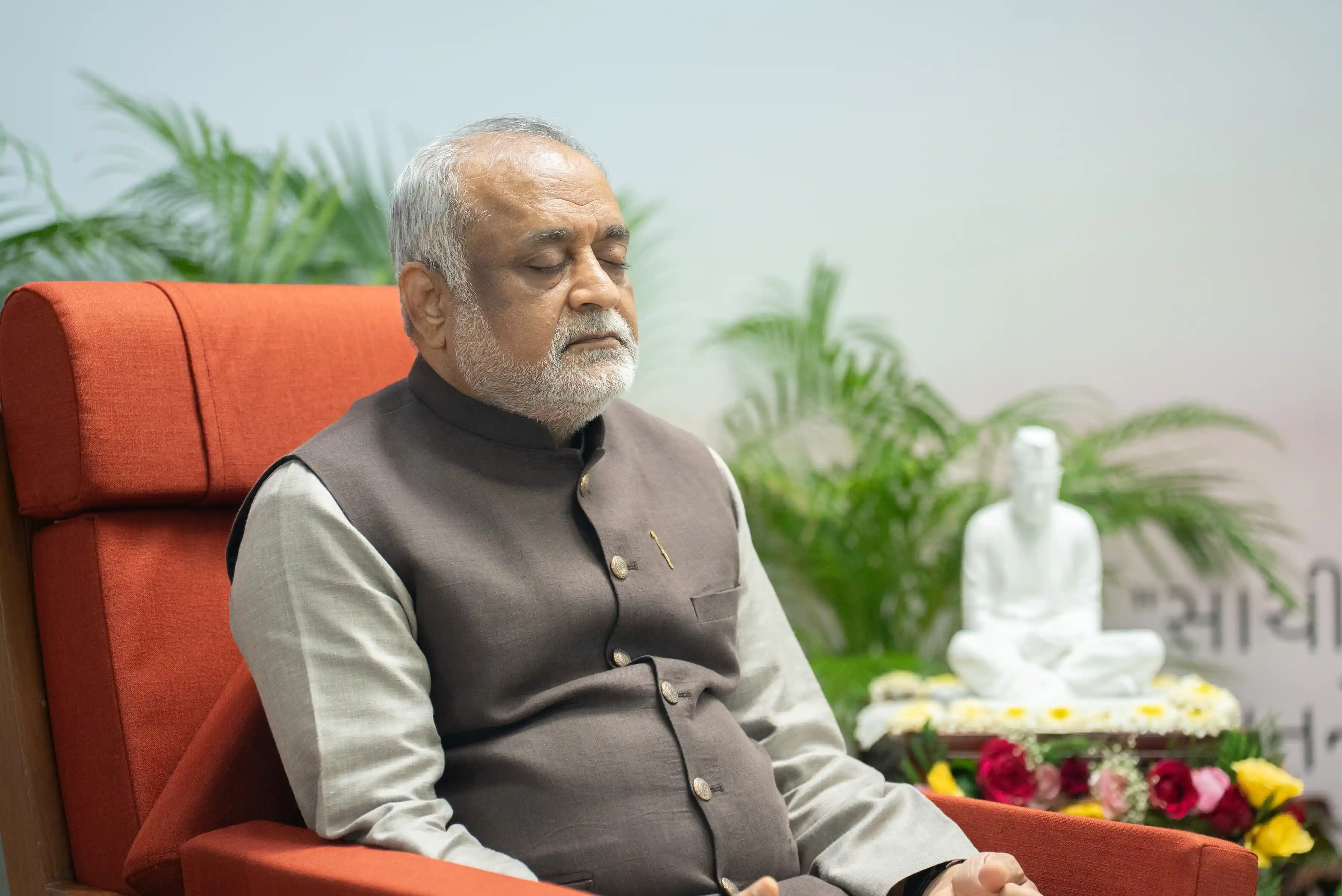
The next morning, the audience that had gathered in the meditation hall included many Heartfulness practitioners from the surrounding villages of Ahmedabad who had been practicing for 3 years or less under the Village Connect Heartfulness program. After the meditation conducted by Daaji, some of the villagers shared their experiences with the Heartfulness meditation practice. Following this, Daaji was interviewed by Dr Harish Dwivedi, Editor-in-Chief of the Jankalyan magazine. This monthly magazine has been publishing philosophical, spiritual, and religious content in Gujarati for the past 74 years, enlightening readers in India and the Gujarati diaspora across the world. Daaji’s articles have been a regular feature in this magazine for the last three years. Here are some translated excerpts from the interview.
Dr Dwivedi: I took my first sitting long back with a preceptor in Ahmedabad, the late Shri Dahyabhai Patel. Then I got busy with my profession, with job transfers and so on and lost touch. Many years later, when I took over the Jankalyan office, I came across a book titled Designing Destiny in Gujarati which had been a gift to the former Editor-in-Chief. I read it and was deeply impressed, finding it remarkable that all its principles aligned with those of Sahaj Marg. Inside, I found a scribbled phone number—it belonged to a preceptor in Ahmedabad, Smt. Tara Chauhan. I reached out to her, and since then, I have revived my practice. I wish to ask you, Daaji, which among all factors mentioned in the book, is the main one that leads to designing one’s destiny?
Daaji: Let me put it this way. Where is our mind? Wherever your thoughts take you, that’s where the mind is. If your thoughts are with your mother, then your mind is with your mother. Where your thoughts take you, your mind follows. The breeze blowing through a garden carries the sweet fragrance of flowers, but if it passes over garbage, it carries a stench. Similarly our thoughts too can bring either sweetness or stench. As your goal is, so are your thoughts; as your thoughts are, so is your mind. So to truly design your destiny, you need to figure out where your interest lies. And when this interest is awakened it can truly transform your life and design your destiny. Suppose your interest is to make fast and easy money, your mind will work toward it, your thoughts will be of a similar nature, it will become your lifestyle, and eventually you will become a thief of great fame. So our goal determines our destiny.
Dr Dwivedi: If anyone from the audience wishes to ask a question to Daaji, please come forward.
Q: In this race, this competition of life, how can Heartfulness be of guidance?
Daaji: Who are you competing with? There are all kinds of competitions in life. Every day, there are various competitions happening all the time with some or the other person. If you try and engage in each and every one, you will lose. Compete with yourself. Don’t compare yourself with others; there is no end to that. Today, you must be better than you were yesterday. Tomorrow, be better than you are today. Lord Krishna said, “Ego manifests in three major ways—self-respect, pride and arrogance. If you are a doctor and say, “I am a doctor,” that’s self-respect. If you say, “I am a good doctor and I will become a better doctor day by day,” that’s a matter of pride as long as you don’t compare yourself with others. But if you say, “There is no better doctor than I,” it becomes arrogance.
Q: I am a vice principal and for 5 minutes or so before each class, I make the children do some meditation. But the teachers in my school warn me that this will make the children too calm and they will lose the spirit of competition. So, is it true that with meditation, the children will lose their desires and spirit of competition?
Daaji: It’s true that the desire to compete diminishes. But they will begin to compete with themselves. They will begin to focus on how they can study better without comparing themselves to other students. They will connect to the source within and develop one-pointed attention and concentration, which automatically brings about cooperation with Nature. But yes, small children up to the age of 15 should not be made to meditate. Do Heartfulness Relaxation with them, in the morning before school starts and at the end before they go home. Also, teach the children that they must go home and at night hold their parents’ feet and do the Relaxation for them. They may begin by saying, “Energy is flowing from me to you.”
Dr Dwivedi: Spiritual Anatomy explains numerous chakras. For the benefit of the layman who may not be well-versed in these concepts, could you highlight the one chakra that serves as the key to overall spiritual progress—much like the saying ek saadhe, badhu saadhe [by mastering one, everything is mastered]?
Daaji: The Heart chakra. Our spiritual yatra [journey] begins in the heart chakra and ends in the heart chakra. The heart chakra is connected to all the other smaller and bigger chakras in the body. So, when we meditate on the heart, the pranahuti [transmission] that we receive with the guru’s grace, enters the heart. And from there, it spreads not only to all the other chakras, but also to all the cells of the body. Hence, meditating on the heart is a very profound and noble practice—Lord Krishna has said it, science says it, yoga treatises say it, and even your own experience says it. In the first sitting [mediation with a trainer] itself, you experience peace. What does that mean? So let’s meditate on the heart and progress ahead.
At the end of the interview, Daaji shared his childhood memories of the Jankalyan magazine. He said, “Ever since I could read, perhaps by the time I was in the 3rd or 4th grade, I have been reading Jankalyan. It used to come regularly to our house in the village; it still does. My father used to read it aloud, with or without an audience! Who knows, maybe some of it would reach someone's ears and contribute to their well-being?!